

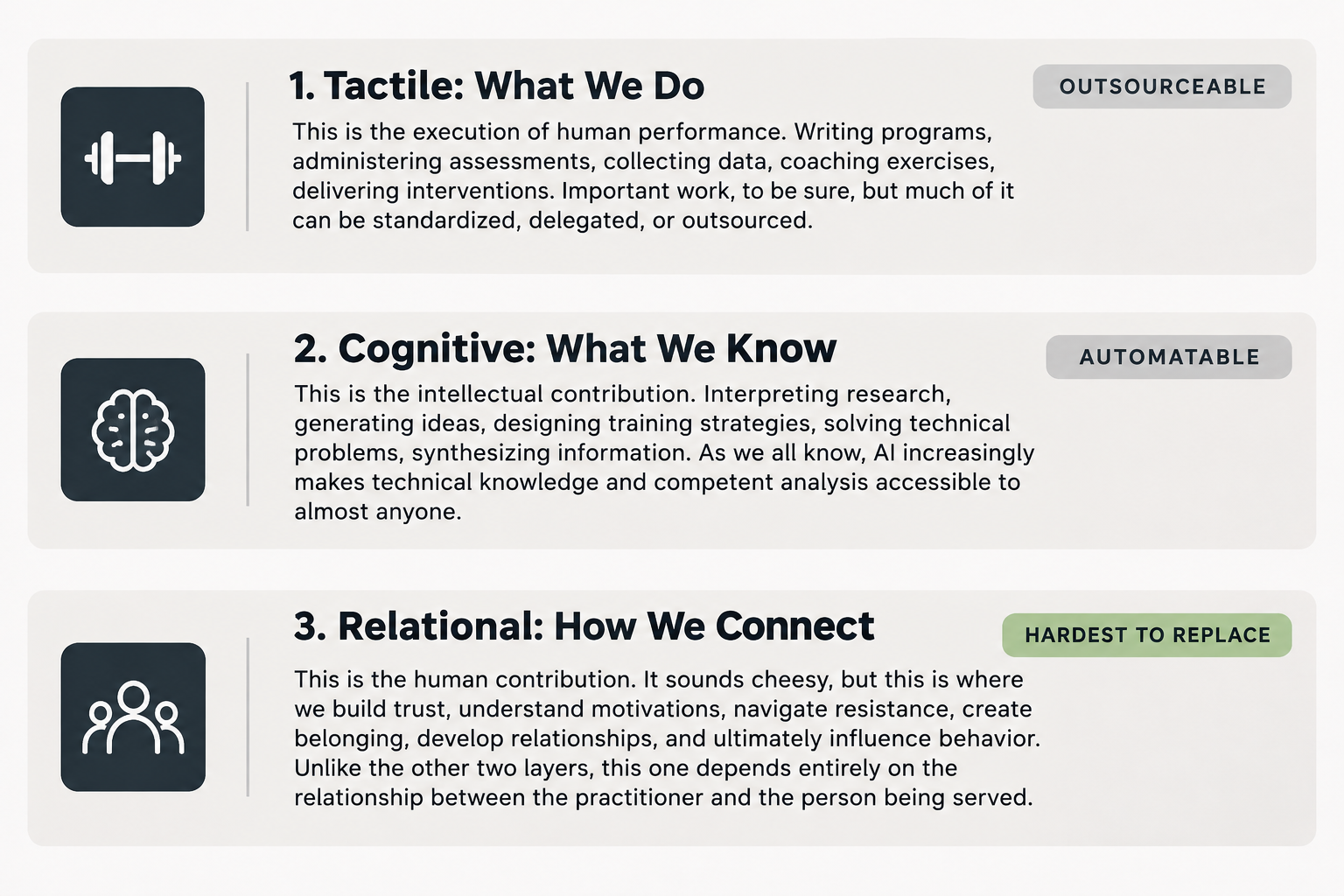
A hierarchy of professional value, organized around how easily that value can be replicated.
When I initially sat down to write this blog post a few weeks ago, it was all about the insanity of thinking you could replace an Athletic Trainer with a 68W (Army medic). Yes, the military has considered doing this.
As the argument developed, however, I started to take a step back and consider a broader discussion: the idea of “irreplaceability” itself, specifically within the ecosystem of military human performance.
For decades, human performance professionals have distinguished themselves by what they can do and what they know. The nuts and bolts of each profession, as it were. But increasingly, what you can do can be outsourced and what you know can be automated. What remains is your ability to connect with another human being…to understand them, earn their trust, influence their decisions, and help them change.
The foundation of this argument is a recognition that a relational layer doesn’t eliminate technical competence; it amplifies it. An excellent relationship without competence is just friendship. Exceptional competence without relationships is just information. The real value exists at the intersection.
And so, having deleted 2,000+ words about Athletic Trainers and Combat Medics, I’d like to begin again by having a conversation about the hierarchy of professional value, organized around how easily that value can be replicated and replaced.
And for what it’s worth, Beyoncé knew about this concept years ago…
The Fear of Being Replaced
Let’s start with a brief aside about why this seems to be a constant topic of conversation in the first place…this idea of being replaced. The first thing you must do is ask yourself a very simple, but revealing, question:
“What do you actually do that someone else – or something else- couldn’t do?”
The truth is that it’s probably less than you think. Most of the tactile skills (programming, research analysis, training recommendations) can be outsourced to artificial intelligence. And the actual coaching or program delivery itself? Contractors can generally do it more cheaply, and if that’s still too expensive, then service members can step in and run PT in a pinch (hell, “it’s the way we’ve always done it,” right??)
What’s interesting is that the anxiety about being replaced actually reveals something about how we’ve defined our value in the first place. We’ve built much of our professional identities around specialized knowledge and technical expertise. But what happens when those things become increasingly accessible?
Three Layers of Professional Value
This is the thought experiment that started to unravel my initial blog post about the simple Athletic Trainer/68W dichotomy.
I call this the Three Layers of Human Performance, organized not in order of importance, but by how easily someone else (or something else) can reproduce their value.
Competence is a Commodity
If you’ll allow me, I’d like to take a second to challenge the traditional notion that expertise is a competitive advantage. It may have been in the past, but I don’t think it is anymore. A technically competent training program? Pretty easy to obtain these days. Information that requires years of formal education? Pretty darn accessible.
I don’t want this to become an AI think-piece, but it’s hard to avoid the topic. AI is accelerating the commoditization of knowledge, analysis, and program design. It’s true everywhere, not just in human performance, but I think in this industry it’s becoming increasingly more difficult to ignore the fact that while being knowledgeable and technically proficient remains essential, those attributes alone are becoming less distinguishing.
To be clear, I’m not saying that competence is becoming less important. It’s not. What I’m saying is that competence alone is becoming less valuable as a differentiator. The argument isn’t against expertise; it’s against assuming that expertise is enough.
Consider two strength coaches.
Coach A has a thorough understanding of program design, stays current with research, and has a LinkedIn-worthy collection of certifications and degrees.
Coach B is technically competent but understands the athletes individually. He knows which one is struggling with their marriage, which one is anxious about an upcoming PT test, which one needs to be challenged, and which one just needs someone to listen. His skill is in knowing how to make people want to participate.
Which coach creates more meaningful change? Until recently, you could probably make the case that Coach A’s specialized knowledge was his competitive advantage. But what happens when motivated athletes can generate perfectly serviceable training programs in 30 seconds? Technical expertise doesn’t become worthless, it just stops being sufficient to differentiate you.
Pause. Before you get upset, you can absolutely position yourself as blend of both A and B. The deeper interrogation of your contribution is where along that spectrum you tend to most often find yourself. More towards Coach A? Replaceable. More towards Coach B? Hard to replicate.
Information Doesn’t Change Behavior: People Do
So much of the internet discourse around tactical human performance focuses on what embedded professionals can and should produce. With this article, I’d like to try and shift some of that towards what embedded professionals are trying to accomplish. And yes, there is a difference.
I don’t care about your class on why sleep matters. Athletes already know that. We don’t need more PowerPoint slides on progressions and regressions of exercises or why physical training is important. Again, your athletes already know that. A cheeky visual handout on dietary recommendations? The soldiers in your nutrition class already have that information readily available at their fingertips.
The challenge isn’t knowing what to do. It’s doing it. Consider the human factors that actually influence behavior:
Trust and psychological safety
Individual motivations and barriers
Personal identity and belonging
Accountability and social influence
Empathy and genuine understanding
A good practitioner can easily prescribe the right workout, but a great practitioner understands why their athlete isn’t doing it. Yes, information can change behavior…and no, a relationship alone might not guarantee it. But meaningful, sustained behavior change often requires more than just information alone.
The Wrong Competitive Advantage
So much of the lens through which we view human performance focuses on the black-and-white lettering of the position descriptions, the professional certifications, and the ROI metrics attached to the program you’re assigned to.
But at the end of the day, strength coaches aren’t ultimately paid to write workouts. Dietitians aren’t ultimately paid to calculate macronutrients. Cognitive Performance Specialists aren’t ultimately paid to teach breathing exercises. Physical Therapists aren’t ultimately paid to prescribe corrective exercises.
All these people are here to help human beings change. Human performance is ultimately about human behavior, and knowledge is only one small component of behavior change.
And yet…
How much of our professional development emphasizes hundreds of hours studying exercise physiology, biomechanics, and (gasp!) periodization? How many certifications do we collect that emphasize technical knowledge? How much of our continuing education and professional conferences focus on increasingly specialized interventions?
How much of that effort goes towards learning how to listen? How to ask better questions? How to build trust with someone who doesn’t want to be there, or how to navigate resistance, conflict, embarrassment, or fear?
Ultimately, across the decades we’ve spent professionalizing what we know and what we do, have we spent nearly enough time professionalizing how we relate to people?
Being Irreplaceable
In writing this piece, I ultimately ended up answering my own question. It wasn’t ever meant to be just about Athletic Trainers versus Combat Medics. That’s a weak argument amongst many similarly weak arguments trying to make the case about how we need to protect our careers.
The broader take-home point is that we’ve potentially misunderstood where much of our greatest impact actually comes from. Rather than worrying about whether our jobs can be outsourced or our knowledge replicated, we ought to be thinking more critically about where we truly can provide value.
Before you get upset, remember…technical competence DOES matter. It always will. But if your entire professional identity rests upon your ability to write programs, interpret research, build PowerPoints, or prescribe interventions, you’re increasingly competing with tools and systems that can do much of that work faster and cheaper.
The irony is that there is quite a bit of opportunity in NOT resisting those changes…in recognizing what those changes reveal about your chosen profession. We’ve all spent an enormous amount of time developing technical expertise, often at the expense of the interpersonal skills required to make that expertise useful. As I’ve always said: if it takes you 10 minutes to explain the deadlift, you don’t understand the deadlift.
Ultimately, if you’re in this line of work, then you’re in the business of working with people. And the better you become at understanding them, communicating with them, and earning their trust, the more effectively you’ll be able to do everything else.
Being irreplaceable isn’t about being the only person who can do the work. It’s about bringing something to the work that isn’t easily replaced.