

Train Like You Park
This is a guest blog post submitted by a member of the M&M Community. The content represents their own views and opinions, with edits made only for grammar, clarity, etc. If you are interested in submitting your own content for consideration, click here.
Note from Drew: Several years ago, I went on a bit of a rant on the podcast about how annoyed I was with people who back into parking spaces. Given that everyone in the military arrives to work at roughly the same time due to PT, backing into parking spots seemed to create a ton of confusion and “traffic jams” in the parking lots on post.
For that, I owe an apology.
Since switching to an EV truck with a “frunk,” I have taken to backing into spots now for logistical reasons, and can safely say that it is in many ways the superior art form. I apologize on behalf of my former self.
The article posted below consists of some beautiful prose from a member of our community who has asked to remain anonymous. Despite that, he and I have spoken and I have willfully bent the knee in defeat. Enjoy!
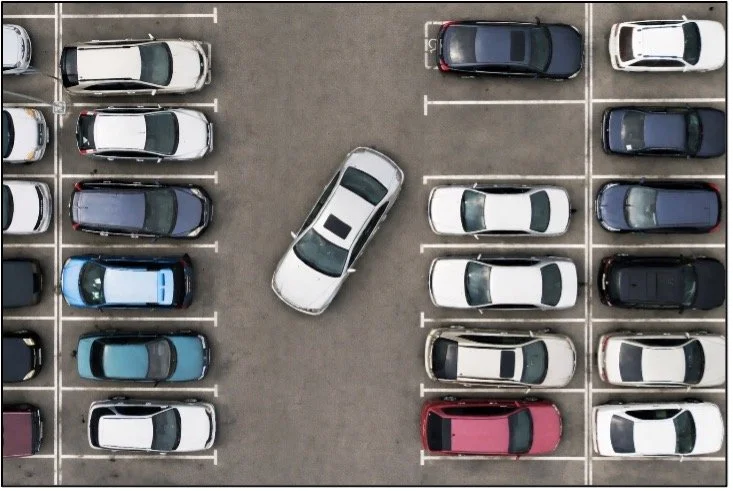
Let’s remove preference from the equation.
Backing into parking spots is, objectively, the correct way to park. Not because it looks disciplined, but because mechanically it makes more sense. The wheels that turn the car are on the front, which means the vehicle’s pivot point favors reversing into tight spaces. When you back in, the steering geometry allows sharper control and cleaner alignment. You typically need fewer corrective movements and fewer point turns because the car rotates more efficiently around its turning wheels.
Pulling forward may feel easier, but it often requires more adjustment, more space, and more micro-corrections to center the vehicle properly. Reverse parking appears harder, yet in practice it is more precise. Many people pull forward because of the illusion that they will “hold up the line.” In reality, you will hold up the line when you back out to leave, and it often takes longer because it is more difficult to survey both approaches through mirrors and cameras than through the windshield. For those who back in, this is never an issue.
This gap between what feels easier and what is structurally better mirrors the gap most people live in when training their bodies.
When you arrive somewhere, you are alert, calm, and unhurried. Backing into a space places the technical maneuver at the moment when your attention is highest. When you leave, you simply drive straight out with full visibility. The system is optimized: effort is applied deliberately on the front end so departure is simple and controlled.
Most people do not train this way.
They “pull forward” into workouts by chasing intensity instead of mechanics. They add weight before mastering movement. They prioritize sweat over structure. It feels productive because it is immediate, and it looks impressive because it is visible, but it is inefficient and often ineffective.
Real physical development works like reverse parking. You apply discipline and intention to planning and programming. You invest time in form, mobility, variety, and progression. You build aerobic capacity before demanding repeated high output. You fix imbalances before they become injuries. It takes longer at first, it can feel slow, and it often feels as though you are doing less.
You are not doing less. You are allocating effort intelligently.
Reverse parking exposes something important: most avoidance is psychological, not mechanical. People do not avoid backing in because they are incapable; they avoid it because they do not want to feel temporarily incompetent. They do not want to hold up the line, misjudge the angle, or look unsure.
Training exposes the same discomfort. Slowing down a squat to correct depth feels humbling. Dropping weight to fix form feels like regression. Spending time on mobility instead of max effort feels boring. Building endurance instead of chasing peak output feels unglamorous. Yet this is where durability and resilience are built.
When you consistently back into parking spots, your spatial awareness improves, your confidence grows, and your control sharpens. What once felt awkward becomes automatic. The difficulty was never the maneuver; it was the unfamiliarity. Like making your bed in the morning, backing into parking spots is a small habit that can influence larger behaviors (McRaven, 2017).
Physical training works the same way. When you consistently invest in fundamentals, movement quality becomes automatic. When you build base strength, heavier loads feel stable. When you train with intent instead of ego, your body becomes more resilient.
Forward parking optimizes for immediate comfort.
Reverse parking optimizes for total system efficiency.
Most people optimize their bodies the way they park: for what feels easiest in the moment. But the body keeps score. Poor mechanics accumulate, neglected weaknesses surface, and short-term shortcuts become long-term limitations.
Backing into a parking spot is a small decision, but it reflects a larger philosophy: choose structural advantage over emotional ease. Choose deliberate practice over convenience. Choose improvement over appearance.
Back in, then train the same way.
McRaven, W. H. (2017). Make Your Bed: Little Things That Can Change Your Life… and Maybe the World. Grand Central Publishing.

At the author’s request, this article is being posted anonymously.