

Rethinking Load Carriage
Optimizing Performance While Minimizing Injury Risk
This is a guest blog post submitted by a member of Leg Tuck Nation. The content represents their own views and opinions, with edits made only for grammar, clarity, etc. If you are interested in submitting your own content for consideration, click here.
If you’ve spent any time in the military, you’ve probably heard some version of this:
“Rucking destroys your knees.”
“Road marches ruin backs.”
“Heavy packs are terrible for your joints.”
It’s an easy conclusion to reach. After all, load carriage is consistently associated with high rates of musculoskeletal injury across military populations. Stress fractures, tendinopathies, low back pain, and other lower extremity overuse injuries are common during basic training, military schools, and in operational units.1,2,3
But those statistics don’t tell the whole story. Looking deeper reveals that the relationship between load carriage and injury is considerably more nuanced. Rucking isn’t inherently dangerous. Rather, the injuries associated with load carriage often expose deficiencies in physical preparation and training design.
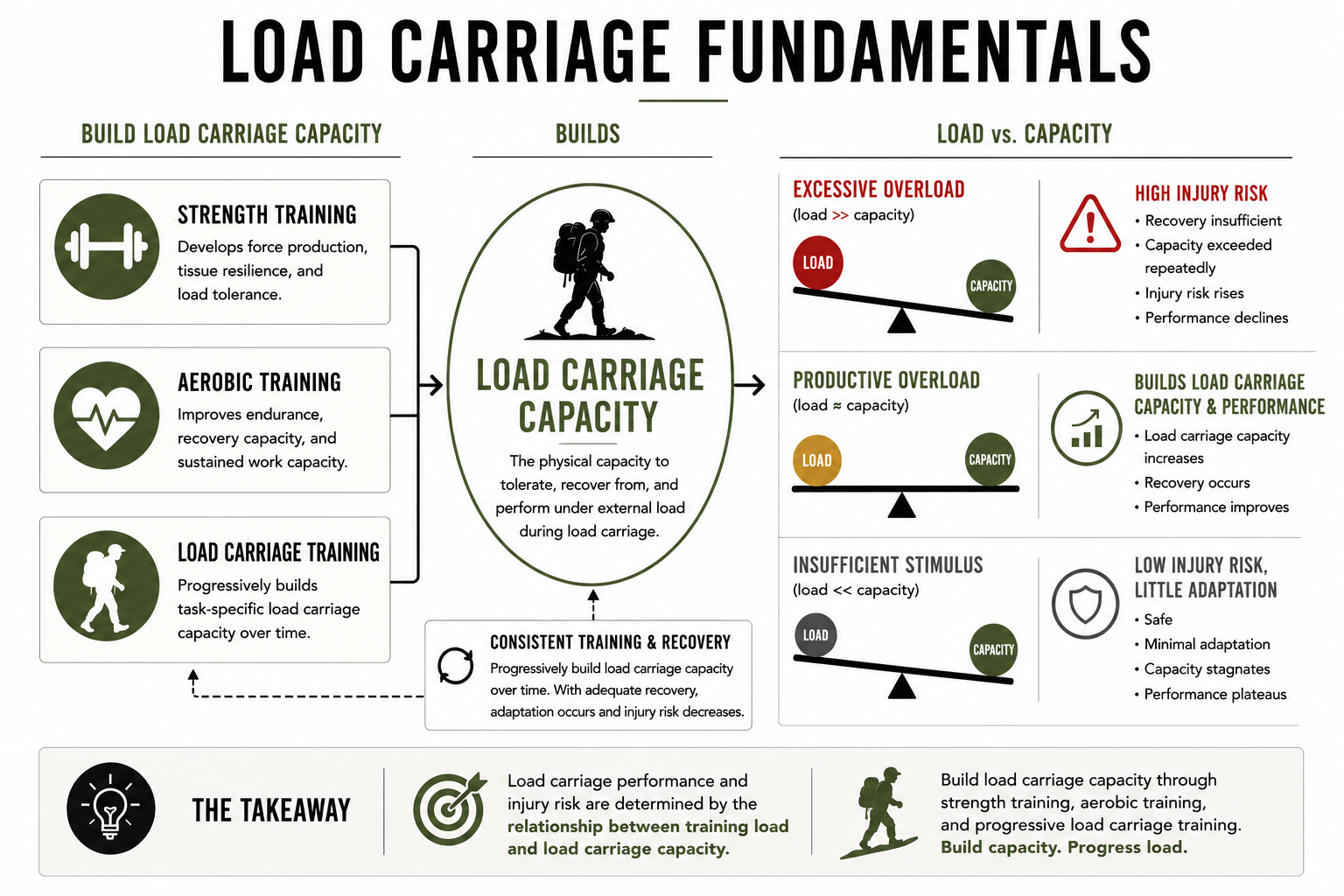
That distinction shifts the question from “Is rucking dangerous?” to “How do we better prepare people to tolerate it?” Figure 1 illustrates a practical framework for answering that question.
We Blame the Activity Instead of the Preparation
Imagine asking an untrained individual to squat 315 pounds tomorrow. If they got hurt, we (hopefully) wouldn’t conclude that squats are inherently dangerous. We’d conclude they attempted a task that exceeded their current capacity.
Yet that’s exactly how we often think about load carriage. Someone with limited aerobic fitness, minimal strength and lean muscle mass, and little recent exposure to heavy loads suddenly spends several hours carrying a 50-pound ruck. They develop musculoskeletal pain, and we blame the rucksack.
In reality, the pain was much more likely the result of a sudden increase in workload that exceeded what their body was prepared to tolerate. That distinction completely changes the solution.
Rather than asking whether rucking is a bad idea, we should be asking how we can better prepare people to tolerate it. There is a tendency in military culture to attribute injuries to the most visible stressor. If a Soldier develops knee pain during a road march, the road march becomes the obvious culprit.
Yet countless service members carry heavy loads throughout long careers with relatively few problems. Rather than trying to minimize a fundamental occupational demand, we should focus on developing the physical capacities that allow service members to tolerate it safely. After all, load carriage isn’t optional in the military.
We Need to Look at the Complete Picture
One of the most common assumptions I see is that the best way to improve at rucking is simply to ruck more.
Specificity certainly matters. If you want to become better at carrying a pack, you have to spend time carrying a pack. But specificity can only take us as far as our underlying capacity allows. Without a broad foundation of strength, aerobic fitness, and progressive load carriage training, both performance and resilience will eventually plateau.
Before someone is ready for long movements under load, they need tissues capable of tolerating those demands. That means developing:
Adequate whole-body strength
Sufficient lean muscle mass
A well-developed aerobic system
Connective tissues progressively exposed to load carriage
These physical qualities create the foundation upon which load carriage can be added on. Better preparation allows service members to tolerate higher workloads, recover more effectively, and perform better when carrying loads.⁴
Aerobic Fitness Builds Your Engine
Ask someone what limits their performance a long ruck and they’ll often mention leg strength.
Strength certainly matters. But it doesn’t tell the whole story. Most loaded movements occur at submaximal intensities, making them predominantly aerobic events. A larger aerobic engine means the same pace requires less relative effort. Heart rate stays lower. Fatigue accumulates more slowly. Movement quality deteriorates less over time. This likely explains why running performance consistently predicts load carriage performance across military populations.²
Aerobic fitness also improves recovery between training sessions. Better-conditioned athletes can generally tolerate higher training volumes, recover more efficiently, and accumulate the repeated exposures necessary for long-term adaptation.
Better aerobic fitness doesn’t replace rucking. It provides the physiological foundation that allows you to perform well during long-duration activities.
Strength Builds Durability
Strength training is often viewed primarily as a way to increase force production. For tactical athletes, however, its more important role may be increasing tolerance. Every increase in maximal strength means a given external load represents a smaller percentage of your total capacity. Likewise, every pound of additional lean muscle mass provides more tissue available to absorb and distribute mechanical stress.
The demands of the ruck don’t change—but the person carrying it does. A stronger, leaner individual is better equipped to tolerate the mechanical demands of load carriage, maintain movement quality as fatigue accumulates, and continue performing when others begin to break down. Put simply, greater strength and lean muscle mass increase the body’s capacity to carry heavy loads, improving performance while reducing the likelihood that training demands exceed tissue tolerance.5,6
Load Carriage Builds the Skill
Strength and aerobic fitness provide the physical foundation for load carriage, but neither can fully replace the adaptations gained from carrying a pack. Like any skill, load carriage becomes more efficient with deliberate practice. Progressive exposure conditions the muscles, connective tissues, feet, and skin to tolerate increasing workloads while improving task-specific movement economy and efficiency under load. These adaptations are unique to load carriage and can only be developed through progressively carrying a pack. While strength builds durability and aerobic fitness builds the engine, load carriage teaches the body how to apply those qualities efficiently under load.
The Real Problem Is Workload Spikes
None of this means load carriage is risk-free. Carrying heavy loads over long distances unquestionably increases mechanical stress on the body.
The question isn’t whether load creates stress—it does. The question is whether that stress exceeds the capacity of the person carrying it.
As illustrated in Figure 1, performance and injury risk are largely determined by the relationship between training load and the physical capacity developed through strength training, aerobic conditioning, and progressive exposure to load. When training load is appropriately matched to capacity (or temporarily exceeds it followed by temporary recovery), the body adapts. Performance improves while injury risk remains relatively low. When training load repeatedly exceeds capacity, without opportunity to recover sufficiently, injury risk rises because tissues are being asked to tolerate more than they have adapted to withstand. Conversely, when training load remains consistently below capacity, injury risk may remain low, but the stimulus is usually insufficient to drive meaningful adaptation. Performance and load carriage capacity eventually plateau or decline.
One finding appears to be clear: rapid increases in workload are associated with a higher risk of injury—not just during rucking, but across endurance sports, resistance training, or really any activity that the body isn’t prepared adequately for. Conversely, individuals who gradually progress to higher chronic training loads often become more resilient to injury in the long-term. Capacity isn’t built by avoiding stress; it’s built by adapting to it. Human tissues respond remarkably well to appropriately dosed mechanical loading, but they adapt poorly to sudden, unaccustomed spikes in training stress.
The Current Reality
Unfortunately, military training still very often includes abrupt increases in load, distance, or pace before tissues have adequately adapted. Whenever this happens, injury risk increases. While these situations aren’t entirely avoidable, many of them are.
Responsibility is shared. Service members have a role in preparing themselves physically before demanding training. Arriving underprepared makes it more difficult for performance teams and unit leaders to safely develop the capacity required for military tasks within often limited training timelines. At the same time, leaders and human performance professionals have a responsibility to recognize where individuals are starting, assess their readiness, and apply training that progressively builds the physical qualities needed for success.
To be fair, this isn’t a simple problem. Training load, tissue adaptation, and workload management are nuanced concepts, and even within the rehabilitation and performance professions our understanding continues to evolve. The goal isn’t to assign blame—it’s to continually improve how we prepare service members. Encouragingly, meaningful progress has already been made. The Army’s implementation of Holistic Health and Fitness (H2F) Teams at the brigade level reflects a growing recognition that thoughtful, evidence-informed training matters. But organizational change takes time, and so does changing long-held cultural beliefs about training, performance, and injury.
As long as suboptimal training practices persist, we’ll continue to see many preventable injuries while blaming the same visible tasks. It isn’t realistic to expect injury rates to ever reach zero—unless we eliminate physical training altogether, which would create an entirely different set of problems. The goal has never been to eliminate injury. The goal is to continually improve how we prepare service members so that preventable injuries become less common while performance continues to improve.
Final Thoughts
Load carriage isn’t going away.
Service members will continue carrying heavy equipment because their jobs demand it. The question isn’t whether they should carry heavy loads. It’s whether they’ve been adequately prepared to do so safely and effectively. Viewed through that lens, rucking begins to look less like a dangerous activity and more like a highly trainable physical skill.
If we want healthier, more resilient tactical athletes, we should spend less time debating whether rucking is inherently dangerous and more time ensuring our training prepares people for the demands they’ll inevitably face. Rucking isn’t the problem. More often than not, inadequate preparation is.
References

Cody Frey is an Army physical therapist and founder of Tactical Vitality, where he writes about evidence-informed strategies to help tactical athletes improve performance, reduce injury risk, and build long-term resilience.