

The Lethality Matrix
A Systems Framework for Practical Programming
While the term “Data” undoubtedly takes the cake when it comes to “most overused buzzword in tactical human performance,” Lethality has to be a close second. We so often hear the term used as a catchall for justifying any and all interventions pertaining to human performance. Heavy deadlifts? They make you more lethal. Running? Lethal. Single-leg back flips? Lethality through the roof.
But what does it really mean? And is it worth leveraging to create some sort of practical framework from which we can make programming decisions? This article aims to find out.
Defining Terms
First, let’s define lethality.
The Oxford Dictionary lays it out thusly: “the capacity to cause death or serious harm or damage.”
Ok. I can accept that. What, then, does it mean to be lethal?
Oxford, again, comes to the rescue with “sufficient to cause death.”
Clearly, dying needs to be an end result for something to be considered lethal. Or, for our purposes, improving lethality must (by definition) directly lead to us causing more deaths…
But that doesn’t really make sense in the context of human performance. I’ve yet to see any Data show that an increase in physical fitness testing leads to more dead bad guys.
Defining Terms Again…But Better!
In an attempt to move away from vague definitions that don’t really mean anything, let’s hone in on defining lethality through the lens of human performance:
Lethality is the ability to apply human capability at the right time, in the right way, to achieve mission success against resistance.
Notice there’s no mention of VO2max, deadlifts, body fat, or even body counts. Those things are inputs. Lethality is the output.
Defining lethality this way also conveniently allows us to avoid Goodhart’s Law. If organizations equate lethality with fitness test scores, they risk optimizing proxies rather than the true outcome. Physical training should aim to improve the foundational capacities that contribute to readiness, while recognizing that mission success ultimately depends on the integration of physical, cognitive, psychological, technical, and team factors in the specific operational environment.
Creating the Matrix
So, if we understand that Lethality is what emerges from the integration of the aforementioned factors, what sort of model can we create that allows us to practically make programming decisions that help improve the performance of our athletes? I’ve intentionally tried to make this as simple as possible, whittling myriad performance factors down to a mere four umbrella categories within which we can start to apply specific, actionable programming decisions. Enter: the Lethality Matrix.
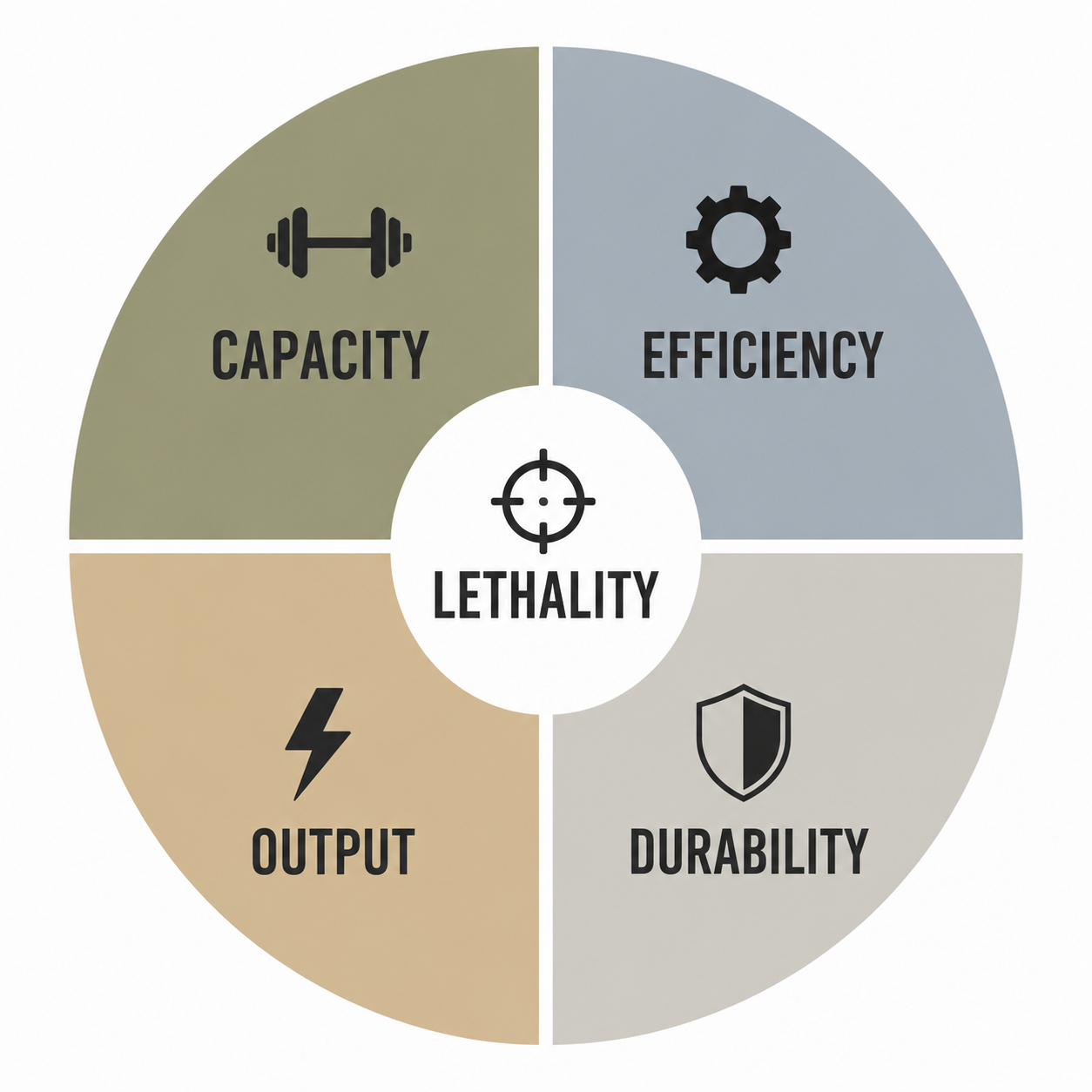
These are four distinct adaptations, each with their own primary training emphasis. More importantly, each domain allows us to actually ask specific questions of our athletes leading directly back to our definition of lethality:
Capacity: how much can you do?
Efficiency: what does it cost you?
Output: how fast can you do it?
Durability: how long can you keep doing it?
Converting to a Training Framework
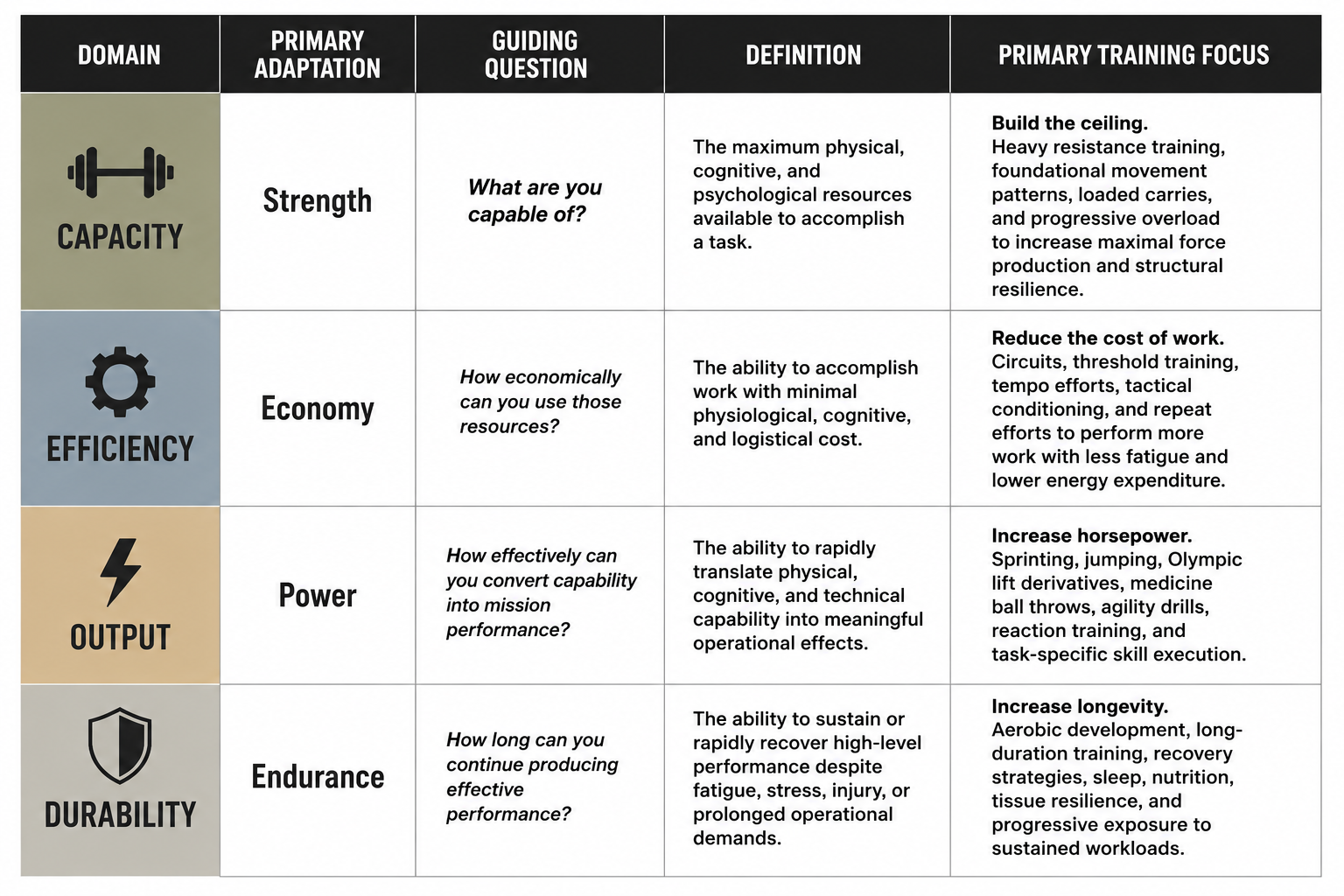
By now, we’ve laid the groundwork for a better approach to understanding lethality through the lens of actionable training interventions. But what does that look like in practice?
Final Thoughts
I know what you’re thinking: “This just looks like normal strength and conditioning.” And in some ways, it is. We’ve trained strength, power, work capacity, and endurance for decades. The novelty isn’t in the exercises or even the adaptations—it’s the organizing principle.
Rather than viewing human performance through the lens of individual disciplines or isolated fitness qualities, this framework organizes every intervention around a common operational objective: actually improving lethality.
Strength becomes a means of increasing Capacity.
Work Capacity becomes a means of improving Efficiency.
Power develops Output.
Endurance builds Durability.
The question we ask shifts from “How do we improve this fitness quality?” to “Which domain is limiting operational performance, and what intervention best addresses it?”
More importantly, the framework creates a common language across disciplines. One thing we suck at in tactical human performance is that every domain tends to speak its own language. Strength coaches think in terms of force production and movement quality. Physical therapists think in terms of tissue tolerance and pain. Dietitians think in terms of energy availability and fueling. Cognitive performance specialists think about attention, decision-making, and learning.
Each discipline is correct within its own domain, sure, but they struggle to communicate how their work contributes to the larger goal. This framework provides a shared vocabulary that aligns every specialty around the same operational objective.
For example, consider with me the domain of Durability. A strength coach may improve it through aerobic development and intelligent load management. A physical therapist contributes by restoring tissue resilience after injury. A dietitian supports it through adequate fueling and hydration. The doc addresses illness or underlying medical conditions that compromise recovery. A cognitive performance specialist develops strategies to maintain decision-making under prolonged fatigue. The interventions are different, but they all serve the same purpose: increasing the operator’s ability to sustain effective performance over time. The same exercise can be repeated for Capacity, Efficiency, and Output, giving every member of the human performance team a direct line of sight between their intervention and its operational impact.
This framework is more than another model of strength and conditioning…it’s an operating system for human performance.
So go forth. Be lethal.