

What PT Tests Can Learn from Drugs
Admit it…you’re curious…
This past weekend, I started listening to a fantastic three-part podcast interview with friend-of-the-show Michael Blevins and former British SAS Operator, Christian Craighead. If Christian’s story is unfamiliar to you, I highly recommend going here to gain a better understanding of what it looks like when one dude decides to go solo into a hostage situation in Nairobi. Also “Obi wan Nairobi” is a hell of a nickname.
The point is, Christian knows what he’s talking about.
What stood out to me early in the interview was a particular discussion on standards, and specifically, whether or not a standard is something that is meant to be achieved or something that is meant to be sustained. I’m adding a bit of my own language there, but when we zoom out and think about it, we get confronted with a pretty interesting thought experiment:
If an organization sets a standard, should it be scheduled months in advance so individuals have time to prepare and peak, OR should it be something that could come down at any time to determine whether individuals are doing what they should be doing to meet that standard?
If you accept this thought experiment as holding any water, it raises a series of interesting questions specific to how the military conducts physical fitness testing. These are the questions I want to explore today, with the ultimate goal of offering a unique—and perhaps even plausible—way forward.
What Is A Standard For?
I’m going to assume we’re all on the same page here in that the military runs PT tests as a way of determining the readiness of the force. Regardless of the branch you serve in, the underlying idea of PT tests is that they serve as…wait for it…the standard. If you can hit these numbers, you’re good. If you can’t, you’re not.
But philosophically, there’s a lot more to it than that. We have to ask ourselves a question:
“What information do we actually want a physical standard to give us?”
If a PT Test exists primarily as a training target, then it absolutely makes sense to schedule it months in advance. Tell service members what they’ll be tested on, give them months to prepare, and see if they’re able to hit the mark when the time comes. Within this model, the standard serves partly as a behavior-change mechanism. It tells service members, “Here is what you need to be capable of, so go become capable of it.”
What is interesting about this mindset is that it tends to drive so much of the chaos that we’ve seen lately in “Military PT Test Land.” Specifically, it leads to circuitous debates around which movements should or shouldn’t be included in the test. “Here is what you need to be capable of” is a phrase that requires us to first determine what the “what” actually is. For some people, that “what” involves deadlifts, sprint-drag-carries, and leg tucks. For others, all you need are runs, sit-ups, and push-ups.
This mindset is also incredibly ironic. Per policy, we’re not meant to view PT tests as training targets; rather, we’re meant to view them as measures of readiness. But when a test is a measure of readiness, you need to be asking different questions. It’s not a matter of whether someone can become fit enough to pass…it’s a question of whether or not they are currently fit enough to perform their duties. If we acknowledge that that’s the question we’re wanting our PT tests to ask, then giving service members extensive advanced notice changes what we’re actually measuring.
“Can you meet the standard?”
versus
“Do you meet the standard?”
These sound almost identical, but they’re fundamentally different questions. A standard can be a destination we give people time to reach, or it can be a line we expect them to remain above. Those are two very different ideas, and they may require two very different approaches to testing.
Are You Fit on a Random Tuesday?
Readiness should describe your normal state, not your peak. We’ve established that there is a difference between being capable of reaching a standard and choosing to live above the standard at all times. So what changes when we adopt a testing policy that leads to us announcing an assessment well in advance?
The obvious answer is that the athletes know the test date. When you know the time and place that something of consequence will occur, you inevitably start to shape your training in such a way that it becomes increasingly specific to the events. This isn’t a character flaw…it’s literally human nature. In fact, it’s a concept we discussed at length in our podcast with C. Thi Nguyen. The overarching training trajectory leading into a scheduled, tested event tends to start to deliberately manipulate conditions to maximize performance on the day.
Again, there’s nothing inherently wrong with this. If the goal is to determine someone’s best achievable performance, it’s exactly what we should be doing (look at the Olympics…). What I would posit, though, is that the purpose of a readiness-based PT test is actually not to determine someone’s peak.
Put another way, the purpose of a fitness test should not actually be to determine someone’s fitness. It should be to determine someone’s preparedness.
Fitness is an underlying physical capacity. For example, Soldier A scoring a 500 on the AFT after an 8-week train-up displays a high level of fitness.
Preparedness, on the other hand, is your ability to express your fitness at any particular moment. Imagine Soldier B scoring roughly a 500 on the AFT any day of the year.
In both Soldier A and Soldier B, we have the same performance number written down on paper, but by this point in my argument it should be very clear to you that we have two very different states of physical readiness.
If physical readiness is supposed to describe a persistent state rather than a performance we periodically manufacture, then perhaps the most informative question our PT Test should be asking isn’t, “How well can you perform on the day we told you to prepare for?”
Maybe it’s much simpler…
“What can you do on a random Tuesday?”
What Urinalysis Gets Right
The point I’m trying to make here isn’t that PT Tests and drug tests are equivalent. They’re not. But if we pause for a second and consider how a random urine analysis is administered, we uncover a pretty interesting truth…
The military already understands that advance notice can undermine the usefulness of certain assessments.
The logic behind a random urinalysis is incredibly obvious. If you were to announce the date of the test well in advance, you’d change the behavior you’re trying to observe. The assessment becomes less representative of someone’s ordinary state (i.e., being high on drugs) because the individual has an opportunity to modify that state specifically for the assessment (i.e., not being high on drugs).
The comparison isn’t perfect, of course. Physical readiness is influenced by fatigue, training load, sleep, injury, and countless other variables that have nothing to do with drug testing. But the underlying measurement problem is similar: once people know exactly when they’re going to be assessed, they can change their behavior specifically for the assessment.
And perhaps that’s exactly what we want. Maybe the fitness test should function as a forcing mechanism…a date on the calendar that encourages soldiers to train.
But if what we’re trying to measure is actual physical readiness, that predictability creates a problem.
Now, it’s important to pause and acknowledge a legitimate counterargument from my estimable colleague, Alex Morrow. Taken directly from our Discord:
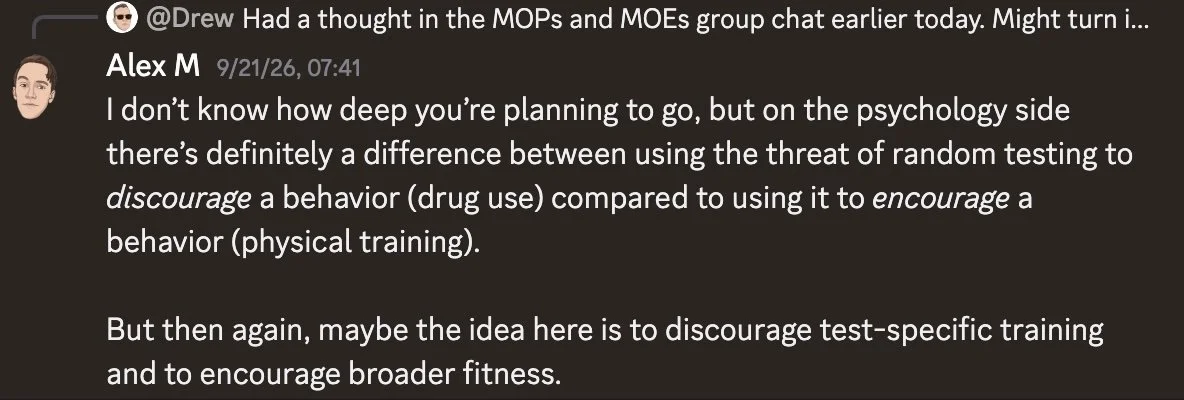
And the thing is, he’s right. There is an obvious limitation to the urinalysis comparison. Random drug testing is designed primarily to discourage a behavior. Physical fitness testing is intended (allegedly) to encourage one.
Those aren’t psychologically identical problems.
The uncertainty of a urinalysis creates a simple incentive: don’t use drugs. The uncertainty of a fitness test could create a much trickier one. Ideally, soldiers would maintain broad physical readiness throughout the year because they could be assessed at any time. But it’s equally plausible that units would simply train the test year-round.
In that case, randomization wouldn’t eliminate test-specific training. It would make test-specific training permanent.
Or…
Perhaps the distinction between drugs and fitness actually clarifies the argument. The goal of random fitness testing wouldn’t necessarily be to make soldiers train more; it would be to change what they train for. When the date of an assessment is known months in advance, the incentive is to prepare for that particular event at that particular time. When the assessment could occur on any given Tuesday, the incentive shifts toward maintaining a level of fitness that can be expressed at any given time. In that sense, randomness might simultaneously discourage test-specific peaking and encourage something closer to persistent, general physical preparedness.
A Different Way Forward
Before I take a bunch of heat, let’s remember that this entire thing is a thought experiment. A byproduct of having too much time in the car and too little else to think about.
So I admit, the implementation details of my little “drug test PT policy” need a bit of work.
That being said, I want to wrap this up by focusing on three key points.
Separate the standard from the test date
If the military says a service member must possess a certain level of physical readiness, then conceptually that standard should apply every day…not just twice a year. The test is simply when we happen to sample it. That would fundamentally change the relationship between training and testing. Instead of organizing training around a date circled on the calendar, the incentive becomes maintaining enough physical capacity that the date matters considerably less.
Random doesn’t have to mean “ambush”
I can acknowledge the obvious operational problems here. Nobody should get pulled off a 72-hour field problem and immediately take a record test. You could have exclusion criteria, minimum recovery periods, medical considerations, and perhaps broad testing windows (ex. complete an AFT by the end of the week). A unit might know it will be tested sometime during a quarter without knowing the exact date. The point isn’t to manufacture failures; it’s to remove the ability to manufacture peak performance.
Maybe the goal isn’t better test performance at all
Maybe it’s changing the culture from “I need to be ready for my PT test” to “I need to be ready.” If physical readiness is genuinely a condition of military service, then perhaps we should stop treating it like an event.
Finally, I’ll close with this. Next time you’re standing there peeing into a cup after randomly getting called in that morning for a drug test, ask yourself one simple question:
“Could I pass my PT test today?”